
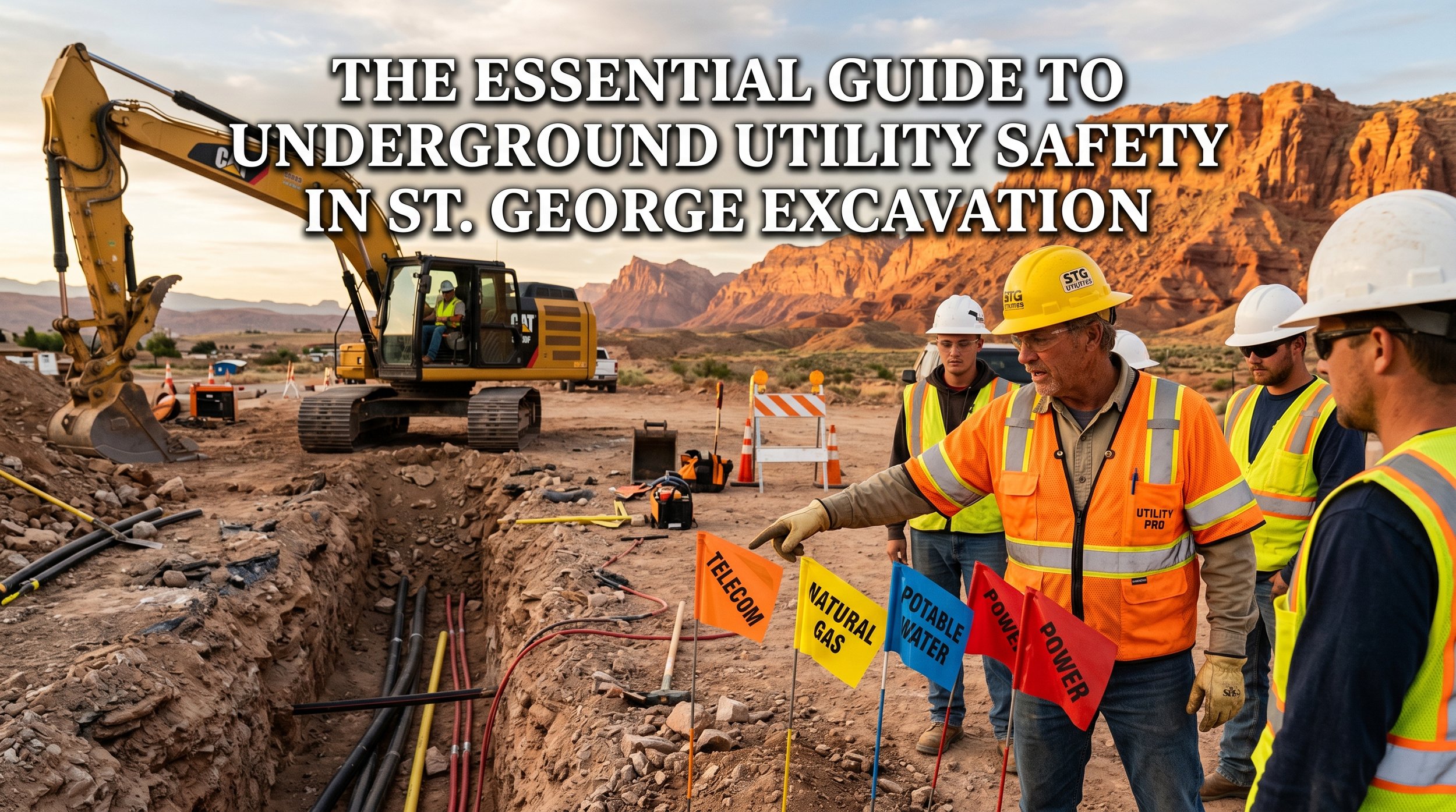
Navigating the hidden infrastructure of a construction site is one of the most high stakes aspects of any land development project. When preparing a site for new construction, the complexity of underground utilities can be staggering, encompassing high voltage power lines, high pressure gas mains, fiber optic communication cables, and complex water networks. In the rapidly growing corridors of Washington County, failure to prioritize underground utility safety St George protocols can lead to catastrophic service interruptions, massive financial liabilities, and severe physical danger to work crews.
For property owners and developers, understanding the invisible grid beneath the surface is a prerequisite for a successful build. This guide explores the rigorous standards of civil site work St. George, detailing the specialized technology and safety frameworks required to move earth without compromising public infrastructure or human life.
Adhering to OSHA Excavation Requirements and Federal Standards
Every professional digging operation in the United States must operate under the strict umbrella of the Occupational Safety and Health Administration. Following OSHA excavation requirements is not merely a legal checkbox; it is a vital life saving strategy. These regulations dictate exactly how a site must be inspected, how trenches must be supported, and who is responsible for the safety of the men and women on the ground.
One of the cornerstones of these regulations is the presence of an excavation competent person. This individual is specifically trained to identify existing and predictable hazards in the working environment. They have the authority to stop work immediately if they notice signs of soil instability, such as tension cracks or "sloughing" in a trench wall. In the diverse soil profiles found in Santa Clara Utah excavation sites, where the ground can shift from stable rock to treacherous loose sand, the oversight of a competent person is the first line of defense against workplace accidents.
Advanced Damage Mitigation: Utility Strike Prevention
In the modern construction era, "digging and hoping" is a relic of the past. Professional utility strike prevention involves a multi-layered approach to identifying buried assets before a bucket ever touches the dirt. This process begins with the "811" or Blue Stakes call, but on complex commercial sites, internal private locating services are often employed to verify the accuracy of public marks.
Ground Penetrating Radar Construction Applications
To achieve the highest level of accuracy, many teams now utilize ground penetrating radar construction technology. This non destructive method sends electromagnetic pulses into the ground to detect reflections from buried pipes and cables. Unlike traditional electromagnetic locators that require a metallic signal, radar can identify plastic, concrete, and clay pipes that are otherwise "invisible" to standard equipment. This technology is particularly useful in St. George when searching for old, undocumented irrigation lines or abandoned utility laterals that are not reflected on modern city maps.
Subsurface Utility Engineering (SUE)
For large scale infrastructure projects, the discipline of subsurface utility engineering provides a structured framework for managing utility risks. By categorizing utility data into different "quality levels" based on the method of identification, engineers can provide developers with a clear picture of potential conflicts. This allows for the redesign of foundations or drainage systems before construction begins, saving thousands of dollars in emergency rerouting costs.
Soft Dig Excavation: The Role of Hydro Excavation Services
When a high priority utility line is known to exist but its exact depth or orientation is uncertain, traditional mechanical digging is far too risky. This is where soft dig excavation techniques become essential. Rather than using a metal bucket that could easily shear through a gas line, crews utilize pressurized water or air to gently move the soil.
Hydro excavation services use a combination of high pressure water and a powerful vacuum system to create "potholes" or "windows" into the ground. This allows workers to visually confirm the utility without any risk of physical impact. In Washington County utility standards, hydro excavation is often mandated when working within the "tolerance zone" of high pressure fuel lines or major fiber optic hubs. This surgical approach ensures that utility damage prevention remains the top priority during the most sensitive phases of site prep.
Structural Integrity: Trench Shoring and Shielding
Even after utilities are located, the physical act of working around them requires a secure environment. Trench shoring and shielding are engineered systems designed to protect workers from the immense weight of the earth. Soil is surprisingly heavy; a single cubic yard can weigh as much as a small car. If a trench wall collapses, it happens in a fraction of a second, leaving workers no time to escape.
Selecting the Right Shielding
Shoring involves using mechanical or hydraulic systems to actively "shore up" or push against the trench walls to prevent movement. Shielding, on the other hand, typically involves the use of a trench box. The box does not necessarily prevent a cave in, but it provides a protected cage for the worker if the earth moves. In Santa Clara Utah excavation, where the soil may be classified as "Type C" (the least stable), using the correct engineered shielding is a mandatory component of safe digging practices.
Washington County Utility Standards for Trenching
Local municipalities often have specific Washington County utility standards regarding how long a trench can remain open and how it must be secured overnight. These rules prevent accidents involving pedestrians or wildlife and ensure that the surrounding pavement or existing structures are not compromised by soil shifting. Proper backfilling and compaction after the utility work is complete are just as important as the initial dig to ensure the long term stability of the site.
Safe Digging Practices for Residential and Commercial Sites
A culture of safety is built on consistent safe digging practices. This begins with the "Blue Stakes" process, where all utility owners are notified of the intent to dig. However, the marks provided by these services are only estimates. Professional excavators in St. George know that they must hand dig or use soft dig methods when within two feet of any marked line.
Furthermore, weather plays a massive role in utility safety. Heavy rains in Southern Utah can quickly turn a stable excavation into a muddy hazard, increasing the weight of the soil and potentially washing away markers. A professional team constantly monitors the site for changes in moisture levels, ensuring that the excavation remains compliant with all OSHA excavation requirements regardless of the environmental conditions.
The Importance of Professional Civil Site Work St. George
Choosing a contractor who understands the nuances of civil site work St. George means choosing a team that values precision over speed. Utility work is often the most time sensitive part of a project, but it is also the area where mistakes are most unforgiving. Whether you are managing utility installation Ivins Utah or a large development in the city center, the quality of the excavation contractor defines the safety of the entire project.
By integrating subsurface utility engineering with modern hydro excavation services, contractors can navigate the underground maze with confidence. This level of professionalism protects the property owner from liability and ensures that the local community’s essential services, power, water, and internet, remain uninterrupted during the growth and expansion of our region.
Frequently Asked Questions
-
Shoring actively supports the walls of a trench to prevent a collapse, while shielding uses a trench box to protect workers if a collapse occurs.
-
An excavation competent person has the specific training to recognize soil hazards and the authority to stop work to prevent accidents.
-
It allows locators to find non metallic pipes like PVC and clay that standard electromagnetic tools cannot detect, preventing accidental strikes.
-
In Utah, the tolerance zone is typically 18 to 24 inches on either side of the marked utility where mechanical digging is prohibited.
-
Hydro excavation should be used whenever you are digging near high risk utilities or in areas where the exact location of a pipe is unknown.
