
Rock Retaining Wall Specialists: Building Walls That Last in Southern Utah's Terrain
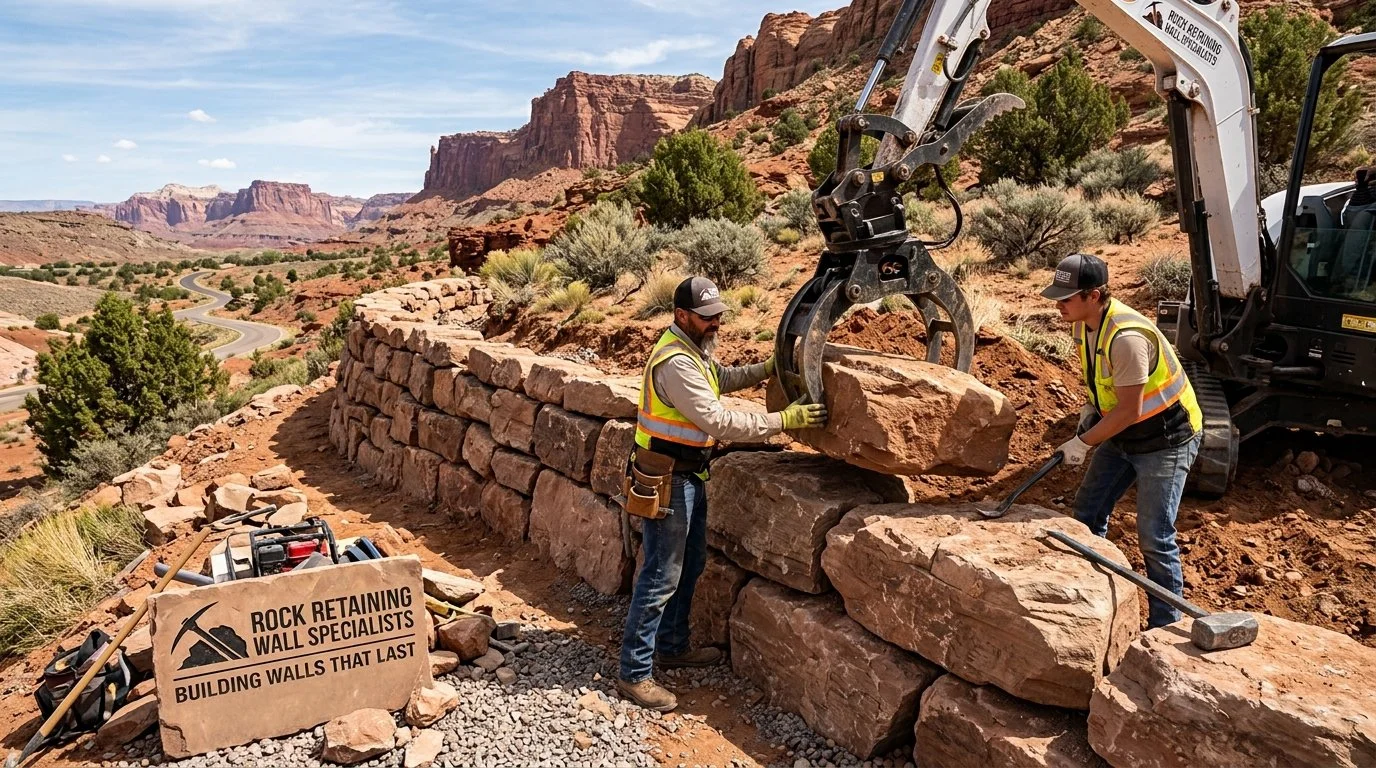
If you own property in St. George, Washington, or anywhere across Southern Utah, you already know the ground here does not behave like the ground almost anywhere else. Steep lots, sandy soil, sudden elevation changes, and the occasional flash flood all put real pressure on a property. A rock retaining wall is often the single most important structure standing between a stable, buildable lot and a slope that slowly gives way. As a rock retaining wall contractor in St. George, Creative Excavating has spent nearly two decades learning exactly how this landscape moves, and building walls that are designed to outlast it.
Why Rock Walls Are Different in Southern Utah
Retaining walls exist to hold back earth and manage grade changes, but the way a wall performs depends entirely on the conditions it is built into. Southern Utah's red rock terrain, expansive clay pockets, and dramatic seasonal swings between bone-dry summers and intense monsoon rain mean a wall that would hold up fine in a mild, stable climate can fail here within a few years if it is not engineered and built correctly.
That is why boulder retaining wall installation in this region is treated as a specialty rather than a generic add-on service. It requires the right attachments and equipment to place and stack boulders with precision, an understanding of how local soil drains, and enough field experience to know how a slope is going to behave once the wall is finished and the ground settles behind it.
How We Approach Boulder Retaining Wall Installation
Every rock wall project starts with an honest look at the lot. We evaluate the grade change, the soil composition, drainage patterns, and how close the wall will sit to a home, driveway, or property line. From there, we determine wall height, footing depth, and whether the project needs engineered plans before a single boulder moves.
What sets a properly installed boulder wall apart is what happens behind it, not just what is visible from the street. We build walls in lifts, typically raising them in roughly two-foot sections, compacting and grading behind each lift before continuing upward. This keeps settling to a minimum and ensures the wall performs the way it was designed to, rather than shifting or bowing over time.
Geo-Grid vs. Filter Fabric: What Actually Goes Behind the Wall
One of the most common questions we get from property owners comparing bids is the difference between geo-grid and filter fabric, and whether it matters which one a contractor uses.
Geo-grid is a rubberized mat placed behind the boulders, between the rock face and the compacted soil. Its job is to reinforce the wall structurally, holding the earth and smaller rock fragments in place even if one of the larger boulders were to shift, such as during an earthquake or after heavy rain saturates the slope. Geo-grid is typically required on taller walls or walls with more aggressive engineering demands.
Filter fabric serves a related but different purpose. It is a permeable barrier that keeps fine soil particles from washing out through the gaps in the wall while still allowing water to drain freely. Poor drainage is one of the leading causes of retaining wall failure, because trapped water builds hydrostatic pressure behind the wall and pushes it outward over time.
At Creative Excavating, filter fabric is standard on every rock wall we build, not an upsell. Many competitors treat it as optional. We do not, because the cost difference is minor compared to the protection it provides, and cutting that corner is one of the most common reasons walls fail early.
Choosing Materials: Red Sandstone, Black Lava, or On-Site Rock
Southern Utah offers a distinct palette of retaining wall materials, and the choice affects both the appearance and, in some cases, the performance of the wall.
Red sandstone is the most recognizable choice in this region, echoing the natural rock formations throughout St. George and the surrounding red rock landscape. It blends naturally into most residential settings and is widely available locally.
Black lava rock offers a striking contrast, often used to create a more modern or dramatic look against desert landscaping. It is dense and holds up well structurally, though it can run at a different cost and availability point depending on the season and supply.
In some cases, particularly during basement excavation or over-dig projects, we are able to use rock pulled directly from the site itself. This can reduce material costs, but it comes with a caveat: we have to assume there is enough usable rock on the property to complete the wall, which is not guaranteed on every lot. We walk clients through this tradeoff honestly before committing to an on-site material plan.
Engineering, Permits, and Height Requirements
A question we hear on nearly every project is whether an engineer is actually required. In most cases in St. George, the answer is yes. Depending on where a project stands, engineering costs can sometimes be rolled into the home's footing engineering if custom plans are already involved, which can save money compared to engineering the wall separately.
Permits are also required for most rock retaining walls in the city. Property owners are technically responsible for filing, but because we work with local building departments regularly, we typically handle that process on the client's behalf to keep the project moving.
Height matters too. St. George code does not allow a continuous rock wall taller than 8 feet before it must be shelved back. A 16-foot grade change, for example, would require an 8-foot wall, a horizontal step-back of several feet, and then another wall section above it. An engineer will test soil moisture and density at regular intervals as the wall goes up to confirm it is being built to code.
Building Near Existing Structures
Retaining walls are far easier, faster, and less expensive to install on an empty lot than around a home or structure that is already built. When a wall has to be cut in close to an existing foundation, the excavation required to properly place the geo-grid can compromise that structure's stability if it is not handled with extreme care.
Whenever possible, we recommend bringing in a rock wall contractor before construction begins, not after. Coordinating the wall with the original site excavation avoids the added time, cost, and risk that comes with retrofitting a wall around a finished structure.
Why Property Owners Choose Creative Excavating
Creative Excavating has been building rock and block retaining walls throughout St. George and Southern Utah since 2005. Our customized attachments allow us to stack a higher quality wall in a fraction of the time compared to conventional methods, which keeps costs down without cutting corners on quality. Filter fabric is standard, our crews understand local code and permitting, and we are upfront with clients about material tradeoffs and engineering needs from the first phone call.
If you are planning a rock retaining wall for a new build, a lot you are considering purchasing, or a property that has started to show signs of erosion, reach out to Creative Excavating for a free estimate before you commit to a direction.
Frequently Asked Questions
Do I need an engineer for a retaining wall in St. George?
In most cases, yes. Southern Utah's soil conditions and code requirements mean the majority of rock retaining walls need engineered plans, though this can sometimes be combined with a home's existing footing engineering to reduce cost.
What is the difference between geo-grid and filter fabric?
Geo-grid is a reinforcing mat placed behind the boulders to hold soil in place structurally, while filter fabric is a drainage barrier that keeps soil from washing out while letting water pass through. Many walls benefit from both, and filter fabric should be standard on every project.
How tall can a rock retaining wall be without extra requirements?
St. George code allows walls up to 8 feet before they must be stepped back. Taller grade changes require the wall to be built in stepped sections rather than one continuous face.
Can a rock wall be added to a property that already has a home or structure on it?
Yes, though it is typically more expensive and complex than building on an empty lot. Excavating close to an existing foundation requires extra care to avoid compromising the structure.
Do I need a permit to build a rock retaining wall?
Yes, permits are generally required in St. George. Creative Excavating works directly with local building departments and typically manages this process for clients.
What type of rock does Creative Excavating typically use?
Red sandstone, black lava, and yellow and white sandstone are the most common choices, and in some cases material excavated directly from the site can be used if enough usable rock is available.
