
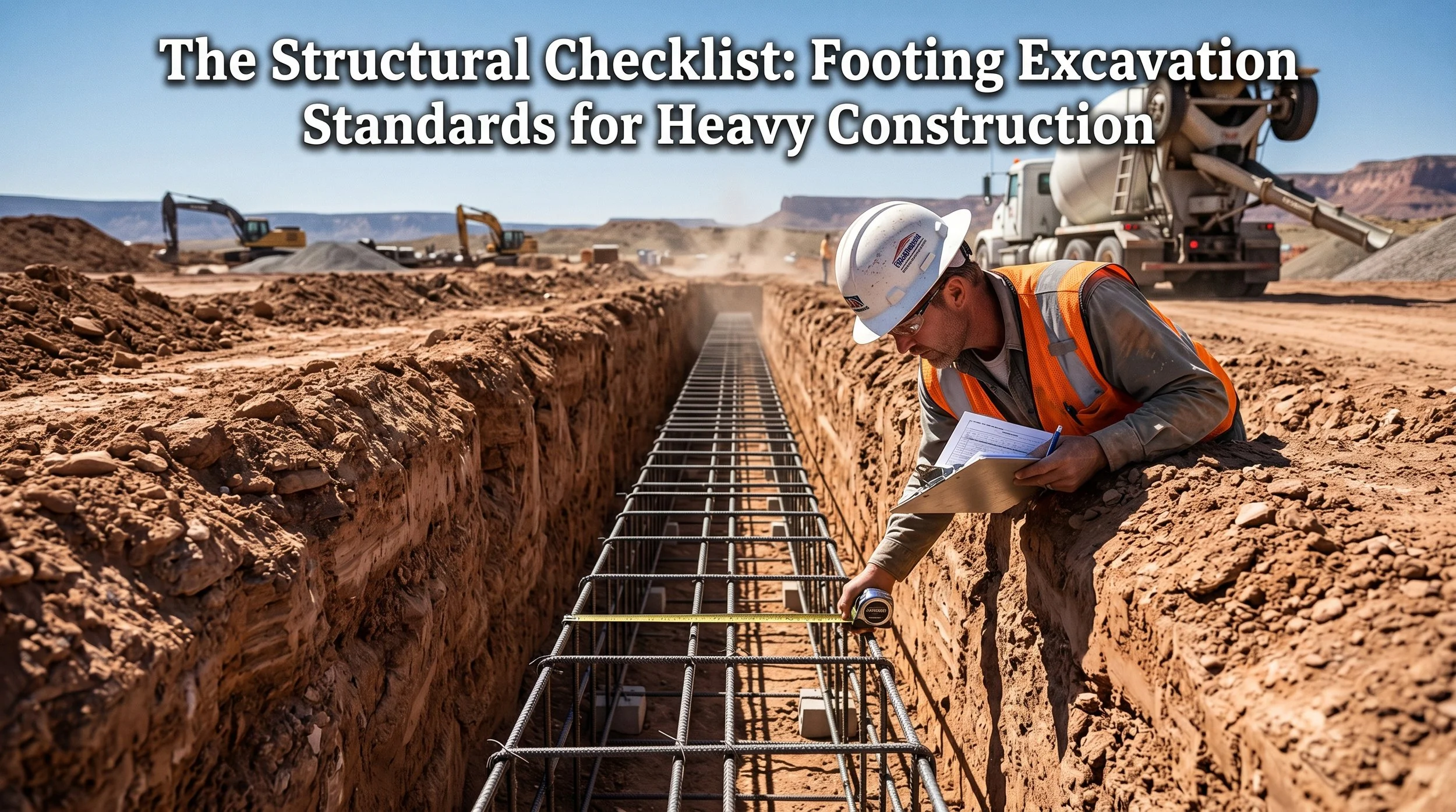
The strength of any commercial or high end residential structure is entirely dependent on the quality of the earthwork performed before the first yard of concrete is poured. The Structural Checklist: Footing Excavation Standards for Heavy Construction is a technical deep dive into the requirements for creating a stable base for massive loads. In the diverse geological landscape of Southern Utah, where soil can range from shifting sands to solid igneous rock, adhering to strict footing excavation standards is the only way to ensure the longevity of a building.
For Southern Utah foundation contractors, the process of digging a foundation is a calculated engineering feat. Every inch of depth and every degree of slope must align with the St. George structural engineering plans to prevent structural failure. This guide outlines the mandatory steps for achieving a build ready site that meets both Washington County building codes and international safety standards.
Verifying the Base: Bearing Capacity Verification
Before an Excavator bucket touches the ground, a Geotechnical Engineer must determine the bearing capacity verification of the soil. This is a measurement of how much weight the Earth can support per square foot. In St. George, where expansive clays are common, this verification often dictates the type of foundation required.
The verification process includes:
Penetrometer Testing: Measuring the resistance of the soil to a probe.
Soil Borings: Extracting deep samples to identify subterranean layers.
Lab Analysis: Determining the moisture content and shear strength of the native earth.
If the soil does not meet the geostructural engineering standards required for the weight of the building, the Contractor must perform a "sub-cut" to remove the poor material and replace it with engineered fill. Without this initial verification, even the thickest concrete footing is at risk of settling or cracking.
Deep Foundation Excavation and Column Pad Excavation
For heavy commercial structures, standard shallow trenches are often insufficient. Deep foundation excavation is required when the load must be transferred to a deeper, more stable layer of soil or bedrock. This often involves the creation of massive Footings or Piers that extend far beneath the surface.
Column Pad Excavation
Large buildings rely on a grid of vertical columns to support the roof and floors. Each of these columns sits on a dedicated pad. Column pad excavation requires extreme precision; the center of the pad must align perfectly with the structural steel grid. These pads are often five to ten feet square and several feet deep, requiring the Excavator Operator to maintain perfectly vertical walls and a clean, level floor to avoid "honeycombing" in the concrete.
Stepped Footing Transition
In the hilly terrain of Washington County, foundations often sit on a slope. A stepped footing transition allows the foundation to follow the grade of the hill while maintaining a level base for the Footings. Each "step" must be dug to a specific height and length to maintain the structural continuity of the reinforced concrete footing prep.
Environmental Standards: Frost Line Depth Utah
A critical factor in Utah commercial site work is ensuring that the base of the foundation sits below the frost line. The frost line depth in Utah varies by elevation, but in the St. George area, it is typically set at 12 to 18 inches. In higher elevations of Washington County, such as Enterprise or New Harmony, this depth increases significantly.
If a footing is installed above the frost line, the moisture in the soil beneath the concrete can freeze and expand. This phenomenon, known as "frost heave," can lift entire sections of a building, causing catastrophic structural damage. Every footing excavation standards checklist must include a verification of the local frost line requirements to ensure the foundation remains stable through the winter months.
Preparing the Trench: Mud Mat Installation and Dewatering
Once the trench is dug to the correct depth, it must be protected from the elements. If a trench remains open and it rains, the bottom can turn into a slurry of mud that ruins the bearing capacity of the soil.
Mud Mat Installation
In high end construction, a mud mat installation is often used. This is a thin layer of low strength concrete poured at the bottom of the excavation. The Mud Mat provides a clean, dry, and level surface for the Ironworkers to tie their Rebar and for the Carpenters to set their Forms. It prevents the structural concrete from mixing with the native soil, ensuring the purity of the mix.
Dewatering Foundation Trenches
In areas with a high water table, such as properties near the Virgin River, dewatering foundation trenches becomes a necessity. Using specialized pumps and well points, contractors must keep the excavation dry until the concrete has reached its initial set. Standing water in a foundation trench is a major violation of Washington County building codes and must be managed around the clock during the pour phase.
Precision and Clearances: Formwork and Rebar Standards
The excavation must provide enough space for the actual construction of the footing. Formwork clearance excavation means digging the trench wider than the footing itself to allow workers to install the wooden or metal forms and to strip them after the concrete has cured.
Adhering to rebar clearance standards is equally vital.
Rebar must never touch the dirt; it requires at least 3 inches of concrete cover in foundations.
The excavation must be clean of any loose debris or "slough" that could get trapped in the Rebar cage.
Structural Engineers will often perform a "pre-pour inspection" to verify that the reinforced concrete footing prep meets the approved plans.
A professional Excavator will use a "flat-bottom bucket" for the final pass of the trench to ensure the floor is perfectly smooth, which minimizes the amount of wasted concrete and ensures the Rebar sits at the correct elevation.
The Final Step: Structural Backfill Compaction
After the Footings are poured and the forms are removed, the void around the concrete must be filled. This is not a place for leftover debris; it requires structural backfill compaction. The soil used for backfill must be an approved granular material that drains well and can be compacted to 95% of its maximum density.
Southern Utah foundation contractors use jumping jacks or plate compactors to work in the tight spaces around the Footings. Each "lift" of soil is typically 6 to 8 inches thick. Proper compaction prevents the ground around the building from sinking, which protects the exterior sidewalks, utility lines, and landscaping from future settlement issues.
Why St. George Structural Engineering Relies on Quality Earthwork
The relationship between the Excavation Contractor and the Engineer is the most important partnership on a job site. St. George structural engineering firms provide the math, but the Excavator provides the reality. If a footing is dug too deep, too shallow, or on unstable ground, the entire project is compromised.
By following a rigorous checklist of footing excavation standards, Contractors ensure that the heavy construction projects in Washington County are built to last for generations. From the initial bearing capacity verification to the final pass of structural backfill compaction, precision in the dirt is the only way to achieve excellence in the sky.
Frequently Asked Questions
-
The Engineer will likely require "over-excavation," which means digging deeper to remove the weak soil and replacing it with engineered aggregate that is compacted in layers.
-
The frost line is determined by the average temperature and the depth to which the ground freezes. St. George is much warmer, so the frost line is shallower than in the northern parts of the state.
-
It is a foundation design used on slopes where the footing "steps" down the hill in increments, allowing the building to stay level while following the natural grade of the land.
-
If Rebar touches the soil, it will absorb moisture and begin to rust. As iron rusts, it expands, which will eventually cause the concrete foundation to crack and fail from the inside out.
-
Contractors use rotating lasers and grade sticks to measure the elevation of the trench floor to within a tenth of a foot during the final phase of excavation.
