
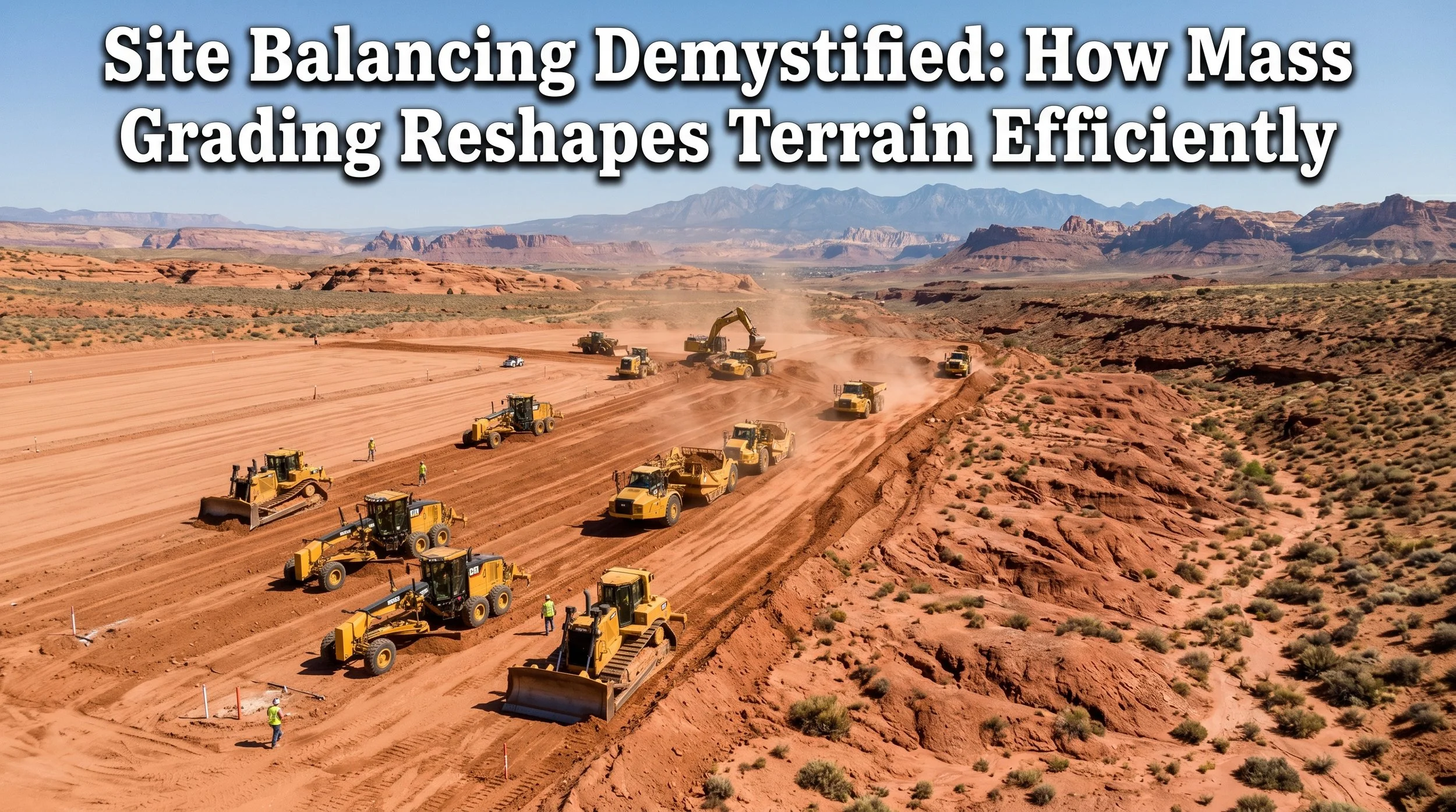
In the world of Utah heavy civil construction, the most dramatic transformation of a property occurs during the mass grading phase. Site Balancing Demystified: How Mass Grading Reshapes Terrain Efficiently explores the complex science of moving hundreds of thousands of cubic yards of Earth to create a functional, level surface for development. In the rugged landscape of Southern Utah, where hills and washes dominate the scenery, mass grading techniques are the primary tools used to turn vertical obstacles into buildable opportunities.
The goal of any high level earthwork project is to achieve a perfect cut and fill balance. This is the mathematical sweet spot where the amount of soil removed from high points perfectly matches the amount needed to raise low points. Achieving this balance requires a combination of advanced software, heavy machinery, and a deep understanding of how soil behaves when it is disturbed.
The Mathematics of Earthwork: Cut and Fill Balance
At its core, mass grading is a giant puzzle. Before a single Engine is started, Engineers use an earthwork volume calculation to determine the site's needs. A "Balanced Site" is the gold standard because it eliminates the need to pay for imported soil or the costs associated with hauling excess dirt to a landfill.
To achieve this balance, Contractors must account for:
Swell Factors: When solid, compacted Earth is dug up, it "swells" because air is introduced into the soil.
Shrinkage Factors: Conversely, when that same soil is placed in a fill area and compacted with a vibratory roller, it "shrinks" as the air is pressed out, often taking up less space than it did in its original, undisturbed state.
Topographic Contour Adjustment: Reshaping the natural lines of the land to manage water runoff while maximizing the usable square footage of the lot.
Understanding swell and shrinkage factors is what separates an amateur estimate from a professional one. In the Red Sand of St. George, these factors can fluctuate significantly, requiring a seasoned Southern Utah master grading expert to make real time adjustments in the field.
Visualization and Strategy: The Mass Haul Diagram
For massive projects like subdivisions or industrial parks, an Excavator cannot simply "eyeball" where the dirt needs to go. A mass haul diagram is a graphical tool used by Project Managers to plan the movement of Earth across the entire site. It shows the cumulative volume of "Cut" and "Fill" along a specific path, helping the team determine the most efficient material haul distance.
By analyzing the mass haul diagram, a Contractor can decide:
Where to establish temporary "stockpiles" for soil that isn't needed immediately.
Which direction the machinery should move to minimize fuel consumption.
The optimal timing for subgrade elevation control checks to ensure the site is staying on track with the master plan.
Efficiency is the name of the game in Utah heavy civil construction. Moving the same pile of dirt twice is a profit killer; the mass haul diagram ensures that every yard of soil moves directly from its origin to its final destination.
The Powerhouse Fleet: Bulk Earthmoving Equipment
Moving mountains requires specialized iron. Bulk earthmoving equipment is designed for high volume production and speed. In the expansive projects found in Washington County, the choice of machinery defines the timeline.
Scraper Fleet Optimization
When the haul distances are long, scraper fleet optimization becomes the priority. Scrapers are unique because they can dig, haul, and spread soil all in one motion. A "Push-Pull" scraper setup, where two machines assist each other in the cut, can move massive amounts of Earth in a single cycle. This is often the most cost effective method for large scale Southern Utah master grading projects.
Dozers and Articulated Dump Trucks
In steeper terrain or when working with rocky soil, a combination of large Dozers and Articulated Dump Trucks (ADTs) is preferred. The Dozer performs the heavy "pushing" to create the initial topographic contour adjustment, while the trucks move material to distant fill areas. This setup allows for greater flexibility when navigating the tight corners and steep grades common in St. George topography challenges.
Precision in the Dirt: Grade Stakes and Hubs
While the machines move the bulk of the material, the precision is guided by a network of grade stakes and hubs. These are physical markers placed by Surveyors that tell the Equipment Operators exactly how much dirt to "Cut" or "Fill" at a specific coordinate.
In modern Washington County land contouring, traditional wood stakes are often supplemented by GPS Grade Control. This technology mounts sensors directly on the Dozer’s blade or the Scraper’s bowl, allowing the machine to automatically adjust its cutting depth based on a 3D digital model of the site. This ensures that the subgrade elevation control is accurate to within a tenth of a foot, significantly reducing the time spent on manual checking.
Finalizing the Surface: Finish Grade Tolerance
Once the mass grading is complete, the site enters the "Finish Grade" phase. This is where the broad strokes of the mass haul are refined into the final shape of the land. Finish grade tolerance refers to the allowable margin of error for the final surface elevation. For building pads and roads, this tolerance is often as tight as 0.1 feet.
To achieve this, Contractors use:
Motor Graders: Also known as "Blades," these machines are the masters of precision, used to create the final smooth surface for asphalt or building foundations.
Water Trucks: Essential in the Southern Utah heat to keep the soil at the "optimum moisture content" for final compaction.
Vibratory Rollers: Used to lock the soil into place, ensuring it meets the required structural density.
Proper site contouring strategies during this phase ensure that water flows exactly where the Engineers intended, protecting the future structures from the flash floods that can occur in Washington County.
Navigating St. George Topography Challenges
Developing land in Southern Utah is not for the faint of heart. The terrain often jumps from soft sand to solid Blue Clay or volcanic Rock within a few hundred feet. Southern Utah master grading requires a Contractor who can pivot strategies based on the material coming out of the ground.
Rock Pockets: May require heavy rippers or blasting to prepare the material for the Scrapers.
Expansive Clays: Often require "over-excavation" where the clay is removed and replaced with stable, non-expansive fill.
Drainage Washes: Must be carefully integrated into the master grading plan to maintain natural water flow while protecting the new development.
By mastering mass grading techniques, a contractor can turn these geographic challenges into assets, creating a tiered or terraced development that provides stunning views and stable building sites.
Why Efficient Site Balancing Matters for Your Budget
At the end of the day, bulk earthwork optimization is about protecting the Developer's bottom line. Soil is one of the most expensive "materials" on a job site simply because of the labor and fuel required to move it. A poorly balanced site results in thousands of dollars wasted on "Export" or "Import" fees.
By choosing a partner who understands Site Balancing Demystified: How Mass Grading Reshapes Terrain Efficiently, you are ensuring that your project starts on a firm, optimized foundation. Precision in the mass grading phase accelerates every subsequent stage of construction, from utility trenching to final paving, making it the most critical investment in any Utah heavy civil construction project.
Frequently Asked Questions
-
Mass grading moves the large volumes of Earth to reach the general shape and elevation of the site. Fine grading is the surgical refinement of that surface to prepare it for concrete, asphalt, or landscaping.
-
If a Contractor doesn't account for these, they may find they have too much or too little dirt at the end of the job. A professional estimate uses soil reports to predict exactly how the Earth will behave when moved.
-
It is a technique where two Scrapers hook together during the loading process. The rear machine pushes the front one to help it cut through tough soil, and then the front machine pulls the rear one to help it fill its bowl.
-
It allows the Contractor to visualize the entire project's earthwork needs, ensuring that dirt is moved the shortest distance possible and that the site remains balanced throughout construction.
-
GPS allows Operators to see the 3D site plan on a screen inside their cab. The machine automatically adjusts the blade to the correct height, eliminating the need for constant manual surveying and re-staking.
