
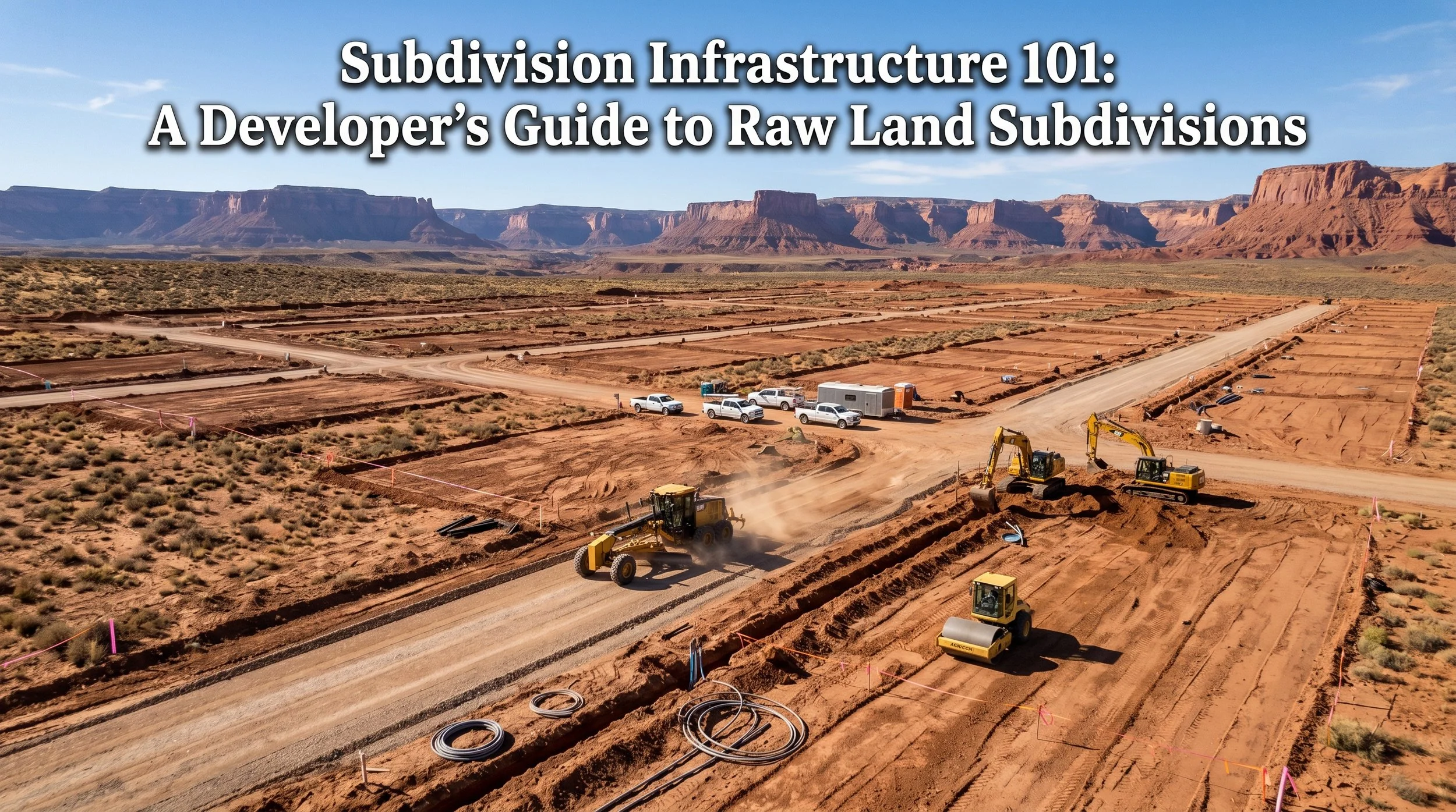
Turning a vast expanse of desert into a thriving residential community is one of the most complex undertakings in the construction industry. Subdivision Infrastructure 101: A Developer’s Guide to Raw Land Subdivisions is designed to pull back the curtain on the massive engineering and earthmoving efforts required before a single home can be framed. In Washington County, this process is particularly demanding due to the rugged terrain and the stringent St. George municipal standards that govern how Southern Utah land partitioning must occur.
For a Developer, the success of a project depends on the invisible skeleton of the neighborhood: the pipes, wires, and road foundations buried beneath the surface. Navigating the transition from raw land subdivision infrastructure to a finished plat requires a strategic approach to residential subdivision earthworks and a deep understanding of how various utility systems must coexist in a limited space.
The Blueprint of Progress: Cadastral Survey Integration
Every successful subdivision starts with precise boundaries. Cadastral survey integration is the first step in translating a vision from a paper map to the actual dirt. This process involves locating legal property corners, establishing centerlines for new roads, and marking the exact locations for future utility mains.
In Southern Utah land partitioning, Surveyors must account for:
Existing easements that may restrict where homes can be built.
Topographical changes that dictate the flow of gravity based utilities.
Setbacks required by local zoning codes in cities like St. George or Ivins.
Once the survey markers are in place, the residential subdivision earthworks team can begin the mass grading phase, shaping the land to match the engineered elevations required for the infrastructure to function correctly.
Liquid Logistics: Sanitary Sewer Collection Systems and Water
The most critical life support systems for any new neighborhood are the water and waste lines. Installing sanitary sewer collection systems is often the most difficult task because these lines must maintain a constant downward slope to function via gravity.
Potable Water Distribution
While sewer lines run deep, potable water distribution networks are usually installed at a shallower, consistent depth. These pressurized systems provide clean water for domestic use and fire protection. In Washington County, water lines must be meticulously bedded in sand to protect them from the sharp rocks common in the local soil. The integration of fire hydrants and water meters at every lot is a key milestone in the infrastructure phase.
Lift Station Excavation
In areas where the natural topography prevents gravity flow, lift station excavation becomes necessary. A Lift Station is a deep underground vault equipped with powerful pumps that "lift" sewage to a higher elevation so it can continue its journey to the treatment plant. These excavations are often twenty feet deep or more, requiring specialized shoring and precision digging to ensure the concrete wet well is perfectly level.
Managing the Elements: Storm Drainage Networks and Retention
In the high desert of Utah, water is a rare but powerful force. Storm drainage networks are designed to capture the intense runoff from summer monsoons and direct it safely away from homes.
A professional master planned drainage strategy involves:
Catch basins installed at low points in the street to collect gutter flow.
Large diameter reinforced concrete pipes buried beneath the roadway.
Retention pond construction at the edge of the subdivision to hold water and release it slowly into the municipal system.
These retention ponds are more than just holes in the ground; they are engineered basins that often serve as dual purpose green spaces or parks for the community. During the infrastructure phase, the residential subdivision earthworks team must ensure the pond is lined and graded exactly to the Engineer's specifications to prevent local flooding.
The Foundation of Connectivity: Road Subgrade Preparation
A road is only as good as the dirt beneath it. Road subgrade preparation is the process of compacting the native soil to a specific density before the gravel and asphalt are applied. In Southern Utah, this often involves moisture conditioning the soil—adding water to reach the "optimum" level for compaction.
Once the subgrade is certified by a Soil Engineer, the team moves on to curb and gutter excavation. This is a high precision task where a machine carves out a trench for the concrete "ribbon" that defines the street. The curb serves two purposes: it creates a structural edge for the asphalt and acts as a concrete channel for the storm drainage networks.
The Utility Corridor Alignment: Organizing the Underground
Beneath a modern street lies a crowded maze of infrastructure. Utility corridor alignment is the practice of assigning specific "zones" for each utility to prevent them from interfering with one another.
Common corridors include:
Deep Zone: Sanitary sewer mains.
Middle Zone: Storm drain pipes and water mains.
Shallow Zone: Power, gas, and telecommunications.
A critical part of this phase is street light conduit trenching. Small trenches are dug behind the curb to house the electrical lines that will eventually power the neighborhood's street lights. Professional Contractors use a utility corridor alignment strategy to ensure that if a water line breaks ten years from now, a repair crew can dig it up without accidentally cutting the neighborhood's fiber optic internet or power supply.
Navigating Washington County Preliminary Plats
The transition from raw dirt to a buildable lot is governed by the approval of Washington County preliminary plats. These documents are the "master rules" for the subdivision, detailing every manhole, fire hydrant, and street sign.
During the construction of raw land subdivision infrastructure, the Contractor must constantly refer back to these Plats to ensure compliance. City Inspectors from St. George or Washington City perform regular site visits to verify that the potable water distribution pipes are at the right depth and that the road subgrade preparation meets the required compaction percentages. Passing these inspections is the only way a Developer can receive the final "Certificate of Completion" required to sell individual lots to Builders.
Why Infrastructure Quality Defines Property Value
The work done during the infrastructure phase is almost entirely invisible once the houses are built, but its quality defines the longevity of the neighborhood. Poorly installed sanitary sewer collection systems lead to backups, and improper road subgrade preparation results in cracked streets and potholes within just a few years.
By investing in high quality residential subdivision earthworks and a robust master planned drainage system, Developers protect their reputation and the long term investment of every homeowner in the community. In the competitive market of Southern Utah, a subdivision built on a foundation of professional infrastructure is one that will stand the test of time.
Frequently Asked Questions
-
A retention pond is designed to hold water permanently (or for long periods), while a detention pond is designed to catch water during a storm and drain it completely over twenty four to forty eight hours.
-
Sewer lines rely on gravity and must start deep enough to allow every house in the subdivision to "drain down" to the main. Water lines are pressurized and can be kept at a shallower, consistent depth.
-
It is the process of aligning the physical construction markers on the ground with the official legal property boundaries and easements recorded with the County.
-
Depending on the rock content of the soil, it typically takes four to six months to complete all earthwork, utilities, and road foundations.
-
Once the Developer completes the project and it passes the "warranty period," the City usually takes over the maintenance of the public roads, water mains, and sewer lines.
